
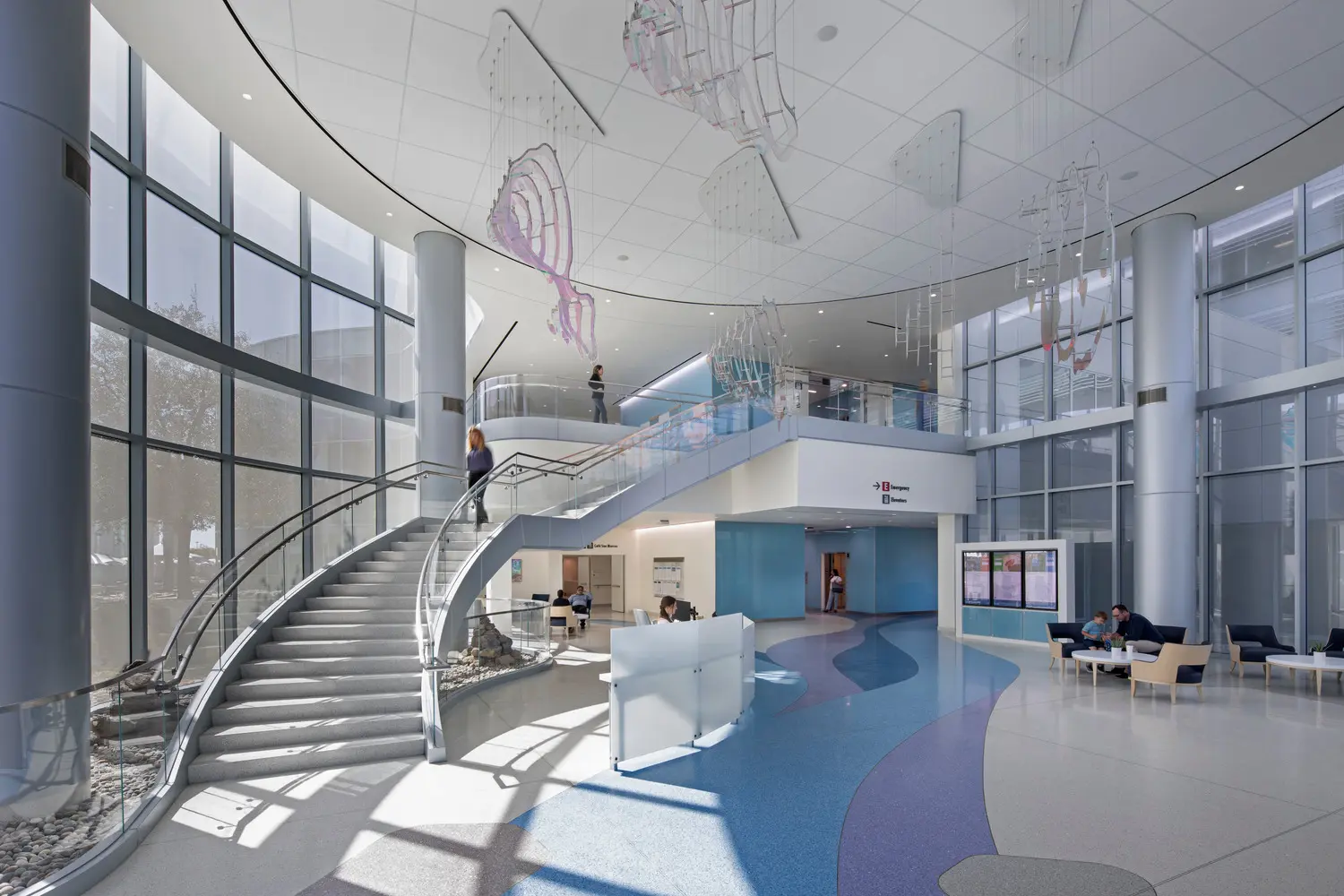
Patient flow architecture and hospital circulation planning by Soul Architects

Hospital Circulation & Workflow Design

Patient Flow Architecture — Designing Hospitals Around Movement, Throughput and Door-to-Doctor Time

Hospital circulation planning, OPD workflow design, emergency-imaging-OT-ICU axis planning, clean and dirty corridor separation, wayfinding architecture and evidence-based patient experience design.

The Architecture of Movement

Hospitals do not run on rooms. They run on the corridors, lifts, queues and adjacencies that connect those rooms.

Patient flow is the most under-appreciated performance variable in healthcare architecture. Two hospitals can have identical bed counts, identical equipment and identical staff numbers and still report very different door-to-doctor times, very different length-of-stay numbers and very different patient satisfaction scores. The difference almost always lives in the architecture — in where the registration desk sits relative to the entry, in how far the emergency department is from imaging, in whether the inpatient lift core is shared with visitors, in whether the discharge lounge exists at all.

At Soul Architects, patient flow is treated as a primary design driver, not a downstream consequence of bubble diagrams. Every hospital, clinic and healthcare campus the studio plans is tested against the patient journey from kerb to consultation, from triage to imaging, from procedure to recovery, from admission to discharge. The architecture must support the workflow, not fight it.

This page documents how the practice approaches patient flow architecture — the principles, the systems, the metrics and the design decisions that turn an ordinary hospital plan into a high-performance clinical environment.

Hospitals in Lucknow, Uttar Pradesh and across India that have invested in evidence-based flow design typically report fifteen to twenty-five per cent improvements in throughput, measurable reductions in staff travel distance and significant improvements in patient experience — all without adding clinicians or beds.

The Patient Journey

Mapping the Journey — Arrival, Triage, Consultation, Diagnostics, Procedure, Recovery, Discharge

Every patient who enters a hospital follows one of a small number of journey archetypes. The outpatient journey moves from arrival to registration to consultation to diagnostics and back. The emergency journey moves from kerb to triage to resuscitation to imaging to admission or discharge. The surgical inpatient journey moves from admission to pre-op to operation theatre to recovery to ward to discharge. The critical care journey moves from emergency or OT to ICU to step-down to ward to discharge.

Designing hospital architecture without mapping these journeys first is the single most common mistake in healthcare planning. Soul Architects begins every project by sketching each journey across the proposed floor plate and identifying the points of friction — the dog-legs, the cross-traffic, the hidden adjacencies, the lift waits, the wayfinding ambiguities.

Once the friction is mapped, the floor plate is reorganised around the journeys rather than around departmental egos. The result is a hospital where the architecture itself feels intuitive to anyone walking through it, whether they have visited before or not.

This is what evidence-based design actually means in practice — not a slogan but a discipline of designing against measurable journey metrics.

Front of House

The First Three Minutes — Kerb, Entry, Registration and Triage

The first three minutes of a patient's experience disproportionately shape their perception of the entire institution. Architecture controls those three minutes more than any other staff intervention. Where does the patient park? How far is the entry from the drop-off? Is the front desk visible the moment the doors open, or hidden behind a column? Does triage sit where it can intercept patients who need it, or is it tucked behind the OPD waiting hall?

Soul Architects designs the front of house so that registration is in the patient's line of sight from the entry, triage has direct visibility to the emergency vestibule, wheelchair access is uninterrupted from kerb to clinic, and visitor flows are clearly separated from clinical flows without feeling exclusionary.

The discipline matters because every metre of confusion at the entry translates into minutes of delay at every downstream station. A good front of house compounds throughput across the entire hospital.

Wayfinding starts here too — not as signage stuck on walls, but as architectural geometry that points toward the next destination.

OPD Circulation

Outpatient Department Planning — The Highest-Volume Flow in Any Hospital

The outpatient department handles the highest patient volume of any hospital department, often four to six times the bed count in daily footfall. Yet OPD is also the department most often planned as an afterthought — a series of consultation rooms strung along a corridor with a waiting hall at one end.

High-performing OPD design treats the department as a workflow system. Consultation rooms are clustered into pods sharing a common waiting bay, with vitals and minor procedure rooms inside the pod rather than at the corridor end. Diagnostics adjacent to OPD — phlebotomy, ECG, x-ray, ultrasound, basic pathology — cut journey time dramatically for the most common patient pathway.

Soul Architects designs OPD as a series of self-contained clinical pods that each function like a mini-clinic, with shared infrastructure such as the pharmacy, billing and main waiting at the OPD core. The result is a department that handles more patients per consultant hour, with shorter wait times and clearer wayfinding, in the same floor area as a conventionally planned OPD.

This approach scales from a fifty-bed nursing home to a multispeciality hospital with thirty consultants on the OPD roster.

Clean and Dirty Corridor Separation

Every hospital handling surgery, critical care or inpatient admissions requires architecturally separated clean and dirty corridors. Sterile supplies, fresh linen, food trolleys, pharmacy stock, scrubbed staff and pre-operative patients move along the clean route. Soiled instruments, biomedical waste, used linen, post-procedure transfers and decontamination logistics move along the dirty route.

The two routes should never share a door, a lift or a junction in the OT, ICU or CSSD zones. NABH evaluates this rigorously, and infection control practice depends on it more than on any single piece of equipment.

Soul Architects plans clean and dirty paths from the concept stage so that the separation is enforced by the architecture itself rather than relying on staff discipline during peak operational pressure.

Read about NABH hospital planning

Horizontal vs Vertical Flow — Choosing the Right Hospital Geometry

Low-rise hospitals on generous sites favour horizontal flow, where high-traffic departments sit on the same floor with short corridors and natural light reaching deep into the plan. The model works well for healthcare campuses, suburban hospitals and projects where the site can absorb a wide footprint.

Mid-rise and high-rise hospitals adopt vertical flow, stacking the emergency-imaging-OT-ICU axis around a dedicated lift core. The core handles critical patient movement while a separate visitor core manages OPD and ward access. Vertical flow is essential in dense urban sites where horizontal expansion is not available.

Choosing wrong — designing a horizontal hospital on a vertical site or a vertical hospital on a horizontal site — creates permanent operational pain. Soul Architects tests both options at the concept stage and recommends the geometry that the site, case mix and capital budget can support.

The Emergency-Imaging-OT-ICU Axis

In any hospital handling acute care, four departments must be planned as a single architectural axis — emergency, imaging, operation theatre and ICU. A polytrauma patient should move from emergency to CT to OT to ICU on a continuous, protected route without crossing public circulation or waiting at lift lobbies.

The axis is typically planned with emergency at the ground floor entry, imaging directly adjacent or one level up via a dedicated lift, OT on the floor above imaging and ICU adjoining or directly above OT with a sterile transfer corridor. The configuration varies by site, but the principle is non-negotiable.

Soul Architects treats this axis as the structural skeleton of acute care hospitals. Every other department is planned around it rather than the other way around.

Explore ICU planning and design

Discharge Lounge Planning — The Most Overlooked Flow

Discharge is the moment where hospital throughput is most often broken. Patients waiting for their final paperwork, prescriptions, billing reconciliation and transport block beds that the next admission needs. A planned discharge lounge — a comfortable waiting space outside the inpatient ward where the discharge process completes — can free up beds two to three hours earlier per admission cycle.

Across a 200-bed hospital running at eighty-five per cent occupancy, that single architectural decision is worth thirty to forty additional admissions per month without adding a single bed.

Soul Architects routinely recommends discharge lounge planning to clients who have never considered it. The capital cost is negligible. The operational impact is significant and immediate.

Wayfinding as Architectural Geometry

The best hospital wayfinding is not signage. It is geometry. A patient should be able to find the imaging department by following the natural pull of the corridor, the change in floor material, the framed view at the end of the corridor, the visible reception desk — not by reading a sign at every junction.

Soul Architects plans wayfinding through the architecture itself. Major destinations are placed at view-terminations. Corridors taper or widen to signal departmental thresholds. Colour, lighting and material change to reinforce zone boundaries. Signage exists as a backup, not as the primary navigation tool.

The discipline matters most for elderly patients, anxious caregivers and first-time visitors, who often represent the majority of OPD footfall.

Visitor, Family and Staff Flow Separation

Modern hospitals manage four parallel flow systems — patients, visitors, staff and materials. Mixing them in the same corridor creates congestion, infection risk and operational confusion. The architecture should provide a primary public flow for OPD and visitors, a clinical flow for patient transfers and staff, a service flow for materials and waste, and a sterile flow for OT and ICU adjacencies.

In practice, this means dedicated lift cores, separated entry points, controlled access at clinical thresholds and clear visual cues at every transition. Soul Architects designs each flow system as a deliberate architectural circuit rather than overlaying them on a shared corridor network.

Measuring What Matters

Flow Metrics — Door-to-Doctor Time, Bed Turnover, OT Turnaround

Patient flow architecture is only as valuable as the metrics it improves. Soul Architects designs every project against measurable performance indicators — door-to-doctor time at OPD and emergency, length of stay against case mix, bed turnover interval, OT turnaround between cases, emergency-to-admission interval, OPD throughput per consultant hour and patient satisfaction at discharge.

Each metric is influenced by a different set of architectural decisions, and the studio publishes a flow performance brief for every hospital project so that clients can measure the design impact rather than rely on aesthetic impression alone.

This is the discipline that separates evidence-based healthcare design from decorative hospital architecture. The flow either improves the numbers, or the design has failed regardless of how it looks in a photograph.

Explore evidence-based healthcare architecture

Patient Flow in OPD-Only and Day-Care Facilities

Day-care surgical centres, diagnostic facilities and OPD-only clinics need a different flow discipline from full-service hospitals. The patient enters, receives care and leaves on the same day, often within ninety minutes. Every minute of friction is felt acutely.

Architecture for these facilities prioritises single-storey or low-rise circulation, immediate-adjacency diagnostics, clear discharge pathways and a recovery zone that does not feel clinical. The flow principles are the same as hospital flow, but compressed and tuned for shorter encounters.

Explore clinic and OPD design in Lucknow

Why Soul Architects for Patient Flow Architecture

Soul Architects combines healthcare workflow analysis, evidence-based design, NABH-oriented planning, infection control logic and architectural craft into a single integrated practice. Every hospital, clinic and healthcare campus is designed around how people move, not just where rooms sit.

The studio supports new hospital projects, brownfield expansions, OPD redesigns, emergency department upgrades and master planning exercises with the same flow discipline. The objective is to deliver healthcare environments that improve clinical throughput, staff productivity and patient experience together.

Consultation Areas

Planning a Hospital Where Flow Is a Performance Asset?

Whether you are designing a new hospital, redesigning an OPD, planning an emergency department or rethinking the entire patient journey across a healthcare campus, patient flow architecture is the discipline that determines whether the institution will run smoothly or struggle.

Soul Architects delivers hospital planning that treats movement as a clinical and economic performance metric, designed against measurable journey outcomes.

Patient Flow Mapping OPD Circulation Design Emergency Department Planning Clean & Dirty Corridor Strategy Wayfinding Architecture Discharge Lounge Planning Vertical vs Horizontal Flow

Frequently Asked Questions

Patient Flow Architecture FAQs

Patient flow architecture is the discipline of designing hospital circulation, room adjacencies and wayfinding so that patients, staff, equipment and materials move with the least friction. It treats movement as a clinical performance metric rather than an afterthought of building planning.

Door-to-doctor time is shaped by where parking is located, where registration sits, how triage is positioned, how visible the consultation block is from the entry, and how predictable the path between stations feels. Strong circulation design can cut door-to-doctor time by ten to twenty minutes without adding any staff.

Sterile supplies, fresh linen, food trolleys and surgical patients move along clean corridors. Soiled instruments, biomedical waste, used linen and post-procedure transfers move along dirty corridors. Architectural separation reduces cross-contamination risk and is a NABH expectation for any hospital handling surgery or critical care.

Horizontal flow keeps related departments on the same floor with short corridors between them, which works well in low-rise hospitals. Vertical flow stacks high-traffic departments such as emergency, imaging, OT and ICU around a dedicated lift core in mid-rise and high-rise hospitals. The choice depends on site geometry and case mix.

Common mistakes include placing imaging far from the emergency department, routing inpatient circulation through outpatient zones, locating registration too far from the entry, ignoring discharge lounge planning, and designing wayfinding as signage rather than as architectural geometry.

Hospitals measure flow through door-to-doctor time, length of stay, bed turnover interval, OT turnaround time, emergency-to-admission interval and OPD throughput per consultant hour. Architecture can move every one of these metrics if it is designed against them from the start.

WhatsApp
Call WhatsApp Enquire